Nearly a decade after the United Kingdom voted to leave the European Union, the geopolitical and economic environment that shaped the Brexit decision has changed dramatically. What was once envisioned as a decisive step toward national independence and global flexibility is now facing new pressures. Escalating tensions surrounding Iran and instability in West Asia have exposed vulnerabilities in global trade and energy markets, prompting Britain to reconsider how far it can operate outside strong regional partnerships.
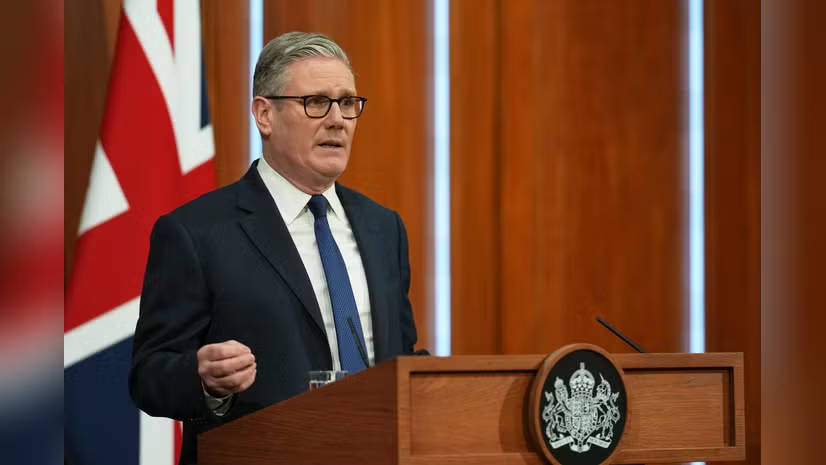
Recent comments by UK Prime Minister Keir Starmer highlight this shift. Speaking earlier this week, Starmer emphasized that Britain’s “long-term national interest requires closer partnership with our allies in Europe.” The timing reflects a growing recognition that geopolitical crises can magnify economic weaknesses, particularly for countries navigating major structural transitions such as Brexit.
The Original Vision Behind Brexit
When British voters chose to leave the European Union in 2016, the campaign centered on the promise of reclaiming sovereignty and control. Supporters argued that exiting the EU would allow the United Kingdom to take back authority over its laws, borders, and trade policy while building a more agile global economy.
This vision was built on the belief that Britain could thrive as a self-reliant trading nation, free from the regulatory frameworks of European institutions. Advocates promoted the concept of “Global Britain,” positioning the country as an independent player capable of forging new international partnerships and trade agreements.
However, the strategy also assumed that the global economic environment would remain relatively stable, with predictable trade routes and cooperative geopolitical relationships. In recent years, that assumption has come under increasing strain.
Economic Frictions Following Brexit
Even before the latest geopolitical tensions emerged, signs of economic strain had begun to appear. Leaving the EU’s single market and customs union introduced new regulatory barriers and administrative checks for businesses trading with Europe, Britain’s largest economic partner.
Supply chains that once operated seamlessly across European borders became more complex and costly. Businesses faced additional paperwork, regulatory differences, and longer transit times. These factors contributed to weaker investment sentiment compared with the years before Brexit.
Economic indicators reflected this slowdown. Britain entered 2026 with limited economic momentum, with gross domestic product expanding by only 0.1 percent in the final quarter of 2025. At the same time, business investment remained subdued, and much of the country’s modest growth was driven primarily by government spending rather than private-sector expansion.
Long-term economic estimates suggest that Brexit may have reduced the size of the UK economy by approximately 2 to 2.5 percent compared with a scenario in which Britain had remained in the European Union. Trade intensity with Europe declined, productivity growth weakened, and the share of UK imports originating from the EU gradually decreased.
These changes did not necessarily insulate Britain from global economic shocks. Instead, they altered the mechanisms through which the UK economy absorbs external disruptions.
The Iran Conflict and Global Economic Pressure
The ongoing geopolitical tensions involving Iran have not created Britain’s structural economic challenges, but they have amplified them. Global markets remain highly sensitive to developments in the Middle East, particularly because of the strategic importance of the Strait of Hormuz.
A significant portion of the world’s oil and liquefied natural gas shipments passes through this narrow maritime corridor. Any disruption to shipping routes in the region can rapidly push up global energy prices, affecting economies far beyond the Middle East.
Although the United Kingdom does not rely heavily on direct energy imports from the region, it remains vulnerable to fluctuations in global energy markets. Rising oil and gas prices quickly translate into higher inflation, increased transportation costs, and pressure on household budgets.
Recent financial assessments have already warned that the Iran conflict is raising risks to global financial stability. Higher energy prices feed directly into domestic inflation and increase mortgage pressures for households. Consumer confidence in Britain has declined sharply amid concerns about rising costs and economic uncertainty.
The impact is already visible in economic data. Retail activity in the UK fell by 0.4 percent in February 2026, reflecting weaker consumer spending even before the full economic consequences of the geopolitical crisis had materialized.
Trade Disruptions and Supply Chain Challenges
Beyond energy prices, geopolitical tensions also threaten global trade flows. Disruptions in the Strait of Hormuz can affect shipping routes, freight costs, and insurance premiums across international markets.
For Britain, these disruptions create an additional layer of complexity. Since leaving the EU’s single market, British businesses already face regulatory hurdles when trading with European partners. When combined with global shipping volatility, these barriers can increase costs and reduce the resilience of supply chains.
As a result, the Iran conflict has highlighted how global crises tend to magnify pre-existing structural weaknesses. For the UK economy, Brexit has not necessarily caused these vulnerabilities, but it has reduced the country’s ability to respond collectively through the coordinated mechanisms available within the European Union.
Uncertainty in the Transatlantic Relationship
Another factor complicating Britain’s strategic position is uncertainty surrounding its traditional alliance with the United States. Historically, the UK has relied heavily on its transatlantic partnership with Washington as a cornerstone of foreign policy and economic cooperation.
However, tensions within the North Atlantic Treaty Organization and the unpredictable foreign policy stance of US President Donald Trump have raised questions about the reliability of this alignment.
Trump has repeatedly criticized NATO allies for not fully supporting US military operations involving Iran and has argued that the alliance depends heavily on American leadership. At the same time, Prime Minister Starmer has made it clear that Britain will not enter the conflict simply due to external pressure.
These differing approaches highlight the growing complexity of international alliances and the need for Britain to balance relationships across multiple geopolitical centers.
Renewed Interest in European Cooperation
Against this backdrop, Europe is once again emerging as Britain’s most stable and immediate partner. Closer cooperation with European neighbors offers practical advantages in areas such as energy security, trade coordination, and defense strategy.
Prime Minister Starmer has called for an “ambitious” reset in relations with the European Union, focusing on practical collaboration rather than ideological debate. He has acknowledged that Britain must work to repair some of the “deep damage” caused by Brexit while still respecting the political realities surrounding the decision to leave the EU.
Importantly, this recalibration does not represent a full reversal of Brexit. Starmer has ruled out rejoining the EU’s customs union or single market. Instead, his approach emphasizes deeper cooperation in key sectors such as trade, security, and energy.
The Future of Brexit in a Volatile World
Britain’s evolving strategy reflects the realities of a rapidly changing global environment. The country is attempting to strike a delicate balance between maintaining the political independence promised by Brexit and ensuring economic resilience in an increasingly uncertain world.
Rather than reversing Brexit outright, policymakers appear to be focusing on making it function more effectively under present conditions. This means strengthening partnerships where necessary while preserving the political autonomy that Brexit supporters demanded.
However, this process is politically sensitive. Brexit remains a deeply debated issue within the United Kingdom, and openly acknowledging its economic limitations carries domestic risks. As a result, government leaders often frame closer cooperation with Europe as pragmatic “damage control” rather than a shift in strategy.
Ultimately, the Iran conflict has served as a powerful reminder that geopolitical shocks rarely occur in isolation. They interact with existing economic structures and policy decisions, shaping how nations respond to crises. For Britain, navigating this new landscape will require careful diplomacy, strategic partnerships, and a pragmatic approach to international cooperation.
Post Views: 1,696