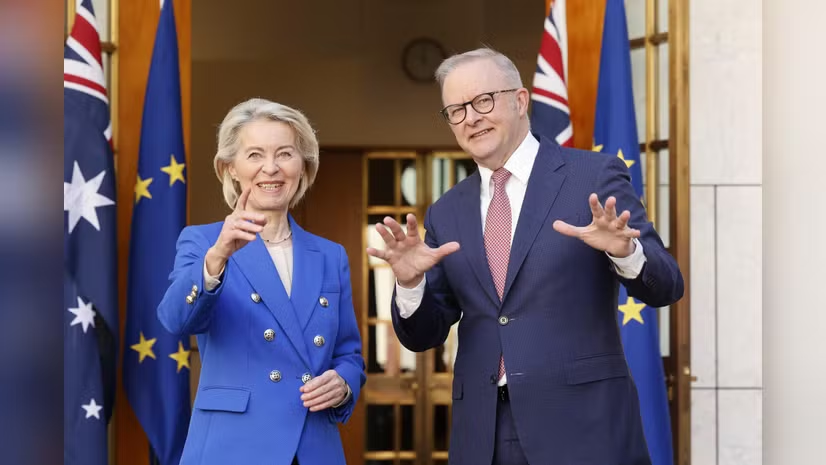
In a significant move to deepen international economic cooperation, the European Union and Australia have successfully concluded negotiations for a comprehensive free trade agreement after nearly a decade of discussions. The announcement was made in Canberra by Australian Prime Minister Anthony Albanese and European Commission President Ursula von der Leyen, marking a major step toward strengthening economic and strategic ties between the two partners.
The agreement represents a shared commitment to expanding trade, promoting economic resilience, and reinforcing a rules-based international order during a period of geopolitical uncertainty. Once formally adopted by the European Council, the deal will proceed through the necessary ratification processes in both jurisdictions before coming into force.
A Major Step Toward Tariff-Free Trade
At the core of the agreement lies a transformative trade framework designed to remove barriers and stimulate economic activity across multiple sectors. One of the most significant provisions ensures that all Australian industrial exports to the European Union will become tariff-free. This measure is expected to provide Australian manufacturers with expanded access to European markets while offering European businesses new opportunities in Australia.
Speaking during the announcement, Ursula von der Leyen described the agreement as mutually beneficial. She emphasized that eliminating tariffs would significantly boost bilateral trade and strengthen economic cooperation between the two regions.
The deal also introduces several provisions aimed at increasing agricultural trade. Australian tariffs on imports such as cheese, meat preparations, chocolate, wine, and sparkling wine will be removed. Meanwhile, the European Union will allow specific quotas for Australian agricultural exports. These include 30,600 tons of Australian beef, with more than half eligible for tariff-free access within ten years after the agreement takes effect.
Additional quotas include 25,000 tons of sheep and goat meat, which will gradually become tariff-free over seven years, along with 35,000 tons of Australian raw sugar cane allowed to enter the EU without tariffs. Smaller quotas for Australian dairy products are also included within the agreement.
However, the deal introduces new rules regarding geographical food labeling. Australian producers will need to stop using certain protected European geographic names for branded products, although some exceptions will remain. Products such as feta and gruyere will continue to be permitted for use by Australian companies.
Strengthening Strategic and Security Cooperation
Beyond trade, the agreement also includes the signing of a Security and Defence Partnership aimed at strengthening cooperation between the two regions in areas such as crisis management and security challenges. This partnership highlights the expanding strategic relationship between the EU and Australia at a time when global security dynamics are rapidly evolving.
The initiative underscores a broader effort by both sides to enhance stability and collaboration across economic, political, and security domains.
Responding to Global Economic Pressures
The agreement comes at a time when both Australia and the European Union are seeking to protect their economies from external pressures. These include tariff policies associated with former US President Donald Trump and ongoing restrictions on critical minerals from China.
In response to these challenges, the European Union has accelerated trade diplomacy with several global partners. Recent trade agreements have also been reached with India and the Mercosur bloc, reflecting a broader strategy to strengthen diversified economic partnerships worldwide.
Trade Potential and Economic Impact
The new EU-Australia trade agreement is expected to generate substantial economic benefits for both sides. According to European trade officials, annual exports of goods and services from the European Union to Australia could increase by approximately one-third over the next decade. Currently, EU exports to Australia total around €65 billion annually.
Trade between the two partners has historically been uneven. According to data from the International Monetary Fund, Australia recorded a trade deficit of approximately $33 billion with the European Union last year. The country exported nearly $12 billion worth of goods to the EU while importing more than $44 billion.
The new agreement is designed to narrow this imbalance by expanding market access, reducing tariffs, and increasing investment flows between the two regions.
A Signal of Global Cooperation
Leaders on both sides view the agreement as more than an economic arrangement—it also represents a broader commitment to international cooperation. Von der Leyen emphasized that the partnership sends a powerful signal about the importance of collaboration and stability during turbulent times.
“These agreements put in place lasting, trust-based structures to support peace and security through strength, driving prosperity through rules-based trade, and working together to uphold global institutions,” she stated.
As global economic alliances continue to shift, the EU-Australia free trade deal stands as a clear demonstration of how strategic partnerships can promote growth, resilience, and cooperation in an increasingly complex world.
Post Views: 1,711