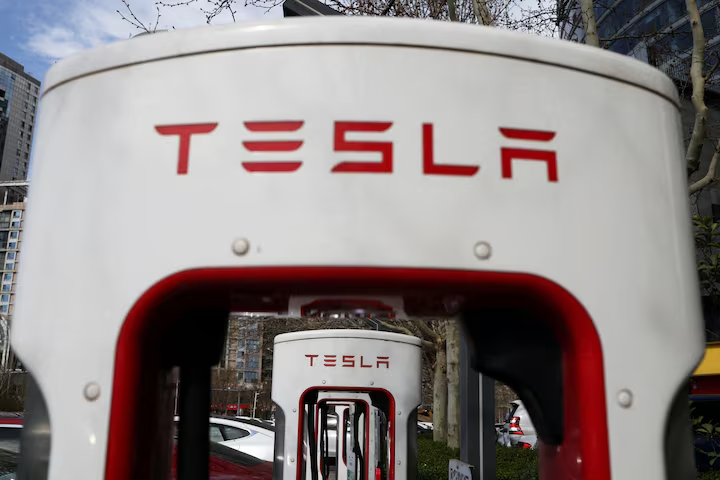
The global electric vehicle market continues to evolve rapidly, and Tesla Inc. has recorded a notable improvement in sales of its China-manufactured vehicles. The American EV giant reported its second consecutive quarter of growth in China-made electric vehicle sales, demonstrating resilience in one of the world’s most competitive automotive markets.
According to data released by the China Passenger Car Association, sales of Tesla vehicles produced in China increased 8.7 percent year-over-year in March, reaching 85,670 units. The figures include both domestic sales and exports to international markets, particularly Europe.
Shanghai Factory Continues to Drive Global Supply
Tesla’s manufacturing facility in Shanghai remains one of the company’s most important production hubs, supplying vehicles not only to Chinese consumers but also to international markets across Europe and Asia.
The growth was primarily driven by strong demand for Tesla’s popular models, the Tesla Model 3 and Tesla Model Y, both of which are manufactured at the Shanghai plant.
March marked the fifth consecutive month of rising sales, reflecting stabilizing demand after a period of market uncertainty and supply chain adjustments. Analysts also noted that recovering European demand contributed significantly to the rise in exports from the Shanghai facility.
Quarterly Growth Signals Recovery
For the January to March quarter, Tesla’s China-made EV sales increased 23.5 percent compared with the same period last year. This represents a substantial acceleration from the 1.9 percent growth recorded in the fourth quarter of the previous year, suggesting that Tesla’s regional operations are regaining momentum.
Industry analysts expect Tesla’s global first-quarter deliveries to rebound by nearly 10 percent compared with the same period last year. The recovery follows a temporary decline in demand, which was partly influenced by consumer backlash related to the political views expressed by Tesla’s CEO, Elon Musk.
Rising Competition in the EV Market
Despite the encouraging sales figures, Tesla continues to face increasing competition from established and emerging electric vehicle manufacturers, particularly within China.
One of the company’s most formidable competitors is BYD Co Ltd, which has rapidly expanded its presence in both domestic and international markets. Chinese automakers have been aggressively developing new EV models, often offering competitive pricing and advanced technology features.
This competitive pressure has had a noticeable impact on Tesla’s market share. In Europe, the company lost nearly half of its market share last year, while its share of China’s EV market declined to approximately 8 percent, down from 10 percent in 2024.
Meanwhile, BYD has continued to expand its global footprint, particularly in Europe. However, analysts note that the company’s strong international growth has not fully compensated for the challenges it faces within its domestic Chinese market.
External Factors Supporting EV Demand
Interestingly, broader geopolitical developments may also influence the electric vehicle market. Analysts suggest that rising global oil prices, partly triggered by tensions involving Iran, could indirectly benefit electric vehicle manufacturers.
Higher fuel costs often encourage consumers to consider alternatives to gasoline-powered vehicles, potentially increasing demand for EVs. If energy prices continue to rise, the shift toward electric mobility could accelerate further.
Tesla’s Expanding Vision Beyond Electric Vehicles
While electric vehicles remain Tesla’s core business, the company is increasingly positioning itself as a broader technology and energy enterprise.
In recent months, Tesla has emphasized future growth areas including solar energy systems, autonomous transportation technologies, and advanced robotics. The company is currently exploring new partnerships in China and has reportedly been in discussions with Chinese firms to purchase approximately $2.9 billion worth of solar equipment to support its renewable energy initiatives.
In addition to solar power, Tesla is investing heavily in autonomous robotaxi networks and humanoid robotics, technologies that the company believes could play a central role in its long-term strategy.
Navigating the Future of the EV Industry
Tesla’s latest sales data underscores the complex dynamics shaping the global electric vehicle industry. On one hand, rising demand for EVs and expanding international markets continue to support growth. On the other, intensified competition and shifting consumer preferences are forcing manufacturers to innovate rapidly.
For Tesla, the continued growth of its China-made vehicles represents an important sign of resilience. With the Shanghai factory serving as a critical production and export hub, the company remains well positioned to compete in both Asian and European markets.
However, maintaining that momentum will require navigating a rapidly changing landscape where technological innovation, geopolitical developments, and competitive pressure are increasingly intertwined.
As the global transition toward sustainable transportation accelerates, Tesla’s ability to adapt and diversify its business may determine its leadership position in the next phase of the electric mobility revolution.
Post Views: 1,552