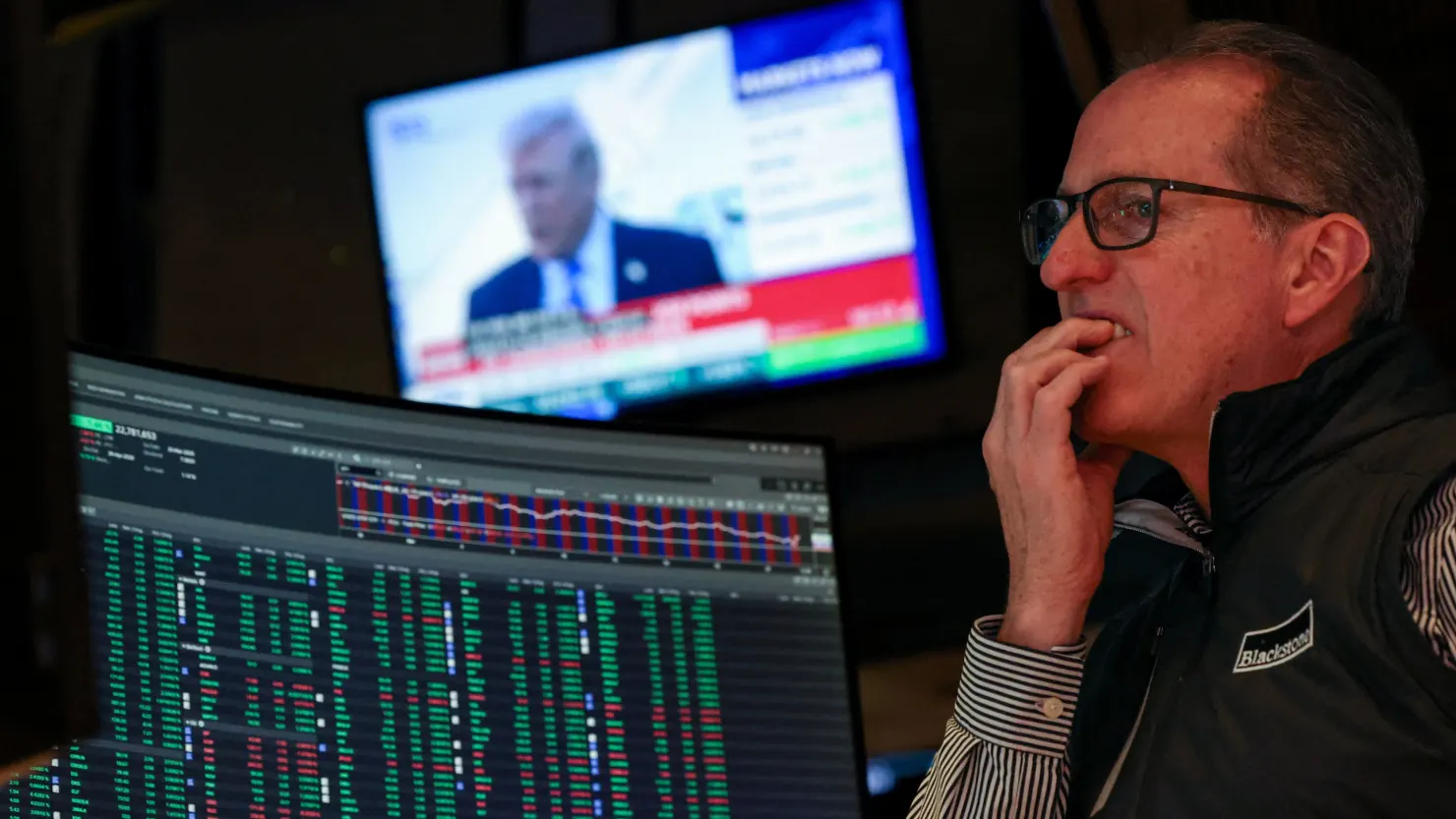
Global financial markets experienced renewed volatility as rising geopolitical tensions in the Middle East sent oil prices soaring and triggered a sharp sell-off in U.S. stock futures. Investor sentiment turned cautious after comments from U.S. President Donald Trump suggested that the conflict involving Iran could continue for several more weeks.
The developments pushed energy prices sharply higher and weighed heavily on equity markets, highlighting the fragile balance between geopolitics, energy supply, and global economic stability.
Stock Futures Slide as Market Anxiety Rises
Futures tied to major U.S. stock indices dropped significantly as investors reacted to the escalating geopolitical situation. Futures linked to the Dow Jones Industrial Average fell approximately 640 points, or 1.4 percent, reflecting widespread market uncertainty.
At the same time, futures for the S&P 500 declined 1.5 percent, while contracts tied to the Nasdaq-100 dropped 1.9 percent, indicating pressure across technology and growth-oriented stocks.
The market reaction underscores how quickly geopolitical developments can influence investor confidence and global financial flows.
Trump Signals Continued Military Pressure
During a late-night address updating the public on the Middle East conflict, President Donald Trump indicated that while the United States may be approaching the end of the confrontation, military pressure on Iran could intensify in the coming weeks.
Trump stated that the U.S. was “getting very close” to resolving the conflict but warned that the country was prepared to respond forcefully against Tehran if necessary. His remarks included a strong warning that the United States could strike Iran “extremely hard,” adding to investor concerns about prolonged instability in the region.
Earlier in the week, Trump had also suggested that U.S. forces might withdraw from Iran within two to three weeks, although the situation remains fluid depending on developments on the ground.
Oil Prices Surge Above $110 per Barrel
The geopolitical uncertainty triggered an immediate reaction in energy markets. Oil prices surged sharply as traders anticipated possible disruptions to global supply routes.
Futures for West Texas Intermediate crude jumped 12 percent, rising above $112 per barrel, while Brent Crude climbed 7 percent, surpassing $109 per barrel.
Energy markets remain particularly sensitive to developments in the Middle East because of the region’s critical role in global oil production and transportation routes. Any disruption to shipping channels or supply chains can quickly push prices higher.
Economic Concerns Begin to Surface
The spike in oil prices is also raising broader economic concerns. Higher energy costs typically translate into increased transportation expenses, higher production costs, and rising inflation, all of which can weigh on consumer spending.
According to Kevin Mahn, prolonged increases in oil prices could slow economic momentum.
“The longer oil prices stay higher, the less consumers will have to spend, and the more the economy will slow,” Mahn explained during an interview on CNBC’s Squawk Box. He also suggested that the Federal Reserve is unlikely to adjust interest rates in the immediate future.
Instead, investors may need to wait for a resolution to the geopolitical conflict before seeing relief in both energy prices and inflation pressures.
Ceasefire Discussions Add Uncertainty
Despite the rising tensions, there have been indications of possible diplomatic developments. President Trump recently stated that Iran’s leadership had requested a ceasefire, though the United States has not yet agreed to the proposal.
According to Trump, Washington would only consider such a request once the strategically critical Strait of Hormuz is “open, free, and clear.” The narrow maritime corridor is one of the most important oil shipping routes in the world, handling a significant portion of global energy exports.
The security of this passage remains a key factor influencing both geopolitical stability and global energy prices.
Investors Watch Economic Data
Beyond geopolitical developments, investors are also closely monitoring upcoming economic indicators that could influence market sentiment.
Traders are expected to focus on initial jobless claims for the week ending March 28, which provide insight into the strength of the U.S. labor market. Additionally, the March jobs report is scheduled for release on Friday, offering a broader snapshot of employment trends in the world’s largest economy.
However, with markets closed on Good Friday, Thursday marks the final trading session of the shortened week, potentially intensifying volatility as investors adjust positions ahead of the holiday break.
A Market Caught Between Politics and Economics
The latest developments illustrate the complex relationship between geopolitics and financial markets. While economic data and corporate performance remain important drivers of investor behavior, global political tensions can rapidly reshape market expectations.
For now, traders and investors remain focused on two key factors: the trajectory of the Iran conflict and the direction of energy prices. Both will likely play a significant role in determining market stability in the weeks ahead.
As global markets navigate this uncertain environment, the interplay between diplomacy, military strategy, and economic fundamentals will continue to influence investor confidence and financial performance worldwide.
Post Views: 1,904