Inside India’s AI Impact Summit, where logistical turmoil met unstoppable tech ambition
New Delhi this week hosted one of the largest artificial intelligence gatherings in the world — an event designed to showcase India’s ambitions to become a global AI powerhouse. Instead, the AI Impact Summit unfolded in a swirl of logistical chaos, security confusion and viral controversies.
Yet amid the disorder, one message rang clear: global technology giants remain deeply bullish on India’s AI future.
From Sundar Pichai, CEO of Alphabet, to Sam Altman, the head of OpenAI, executives repeatedly emphasized India’s advantages — a vast engineering talent pool, a fast-growing digital economy and a massive consumer base eager to adopt new technology.
“The excitement here, it’s just been incredible to watch,” Altman said during an interview on the sidelines of the summit.
A Challenging Week on the Ground
For those covering the event, however, enthusiasm often collided with reality.
Traffic in the Indian capital was at a standstill for much of the week — even by New Delhi standards. With events and interviews scattered across three separate hotels, navigating the city became a daily test of endurance. On multiple occasions, vehicles barely moved.
Confusion extended to the summit venue itself — Bharat Mandapam — where media access instructions shifted repeatedly ahead of Prime Minister Narendra Modi’s inauguration of the event.
At one point, it was unclear whether journalists would be permitted entry at all. Eventually, word came that media could enter at 6 a.m. local time. Even then, security delayed access, as crowds of reporters gathered outside the gates. Once inside, conflicting directions from security personnel added to the disarray.
Several delegates privately voiced frustration over the organization of the summit, raising concerns that the execution did not match India’s global AI aspirations.
Indian IT Minister Ashwini Vaishnaw later apologized for the “problems” experienced on the first day.
Controversies and Viral Moments
The summit was also marked by high-profile controversies.
Bill Gates, initially scheduled to deliver a keynote address, became the subject of uncertainty. While the Bill & Melinda Gates Foundation had earlier confirmed his participation, it later announced that the billionaire would not appear, fueling speculation and confusion.
Another flashpoint involved Galgotias University, which reportedly faced removal from the event after controversy over a robot dog displayed at its booth. The robot was identified online as a product of Chinese robotics company Unitree. A professor had described the robot as “developed” by the university, prompting criticism on social media.
The institution later clarified that the project involved programming and deploying globally available tools to help students build real-world AI skills — not manufacturing the hardware itself.
And then there was the moment that went viral.
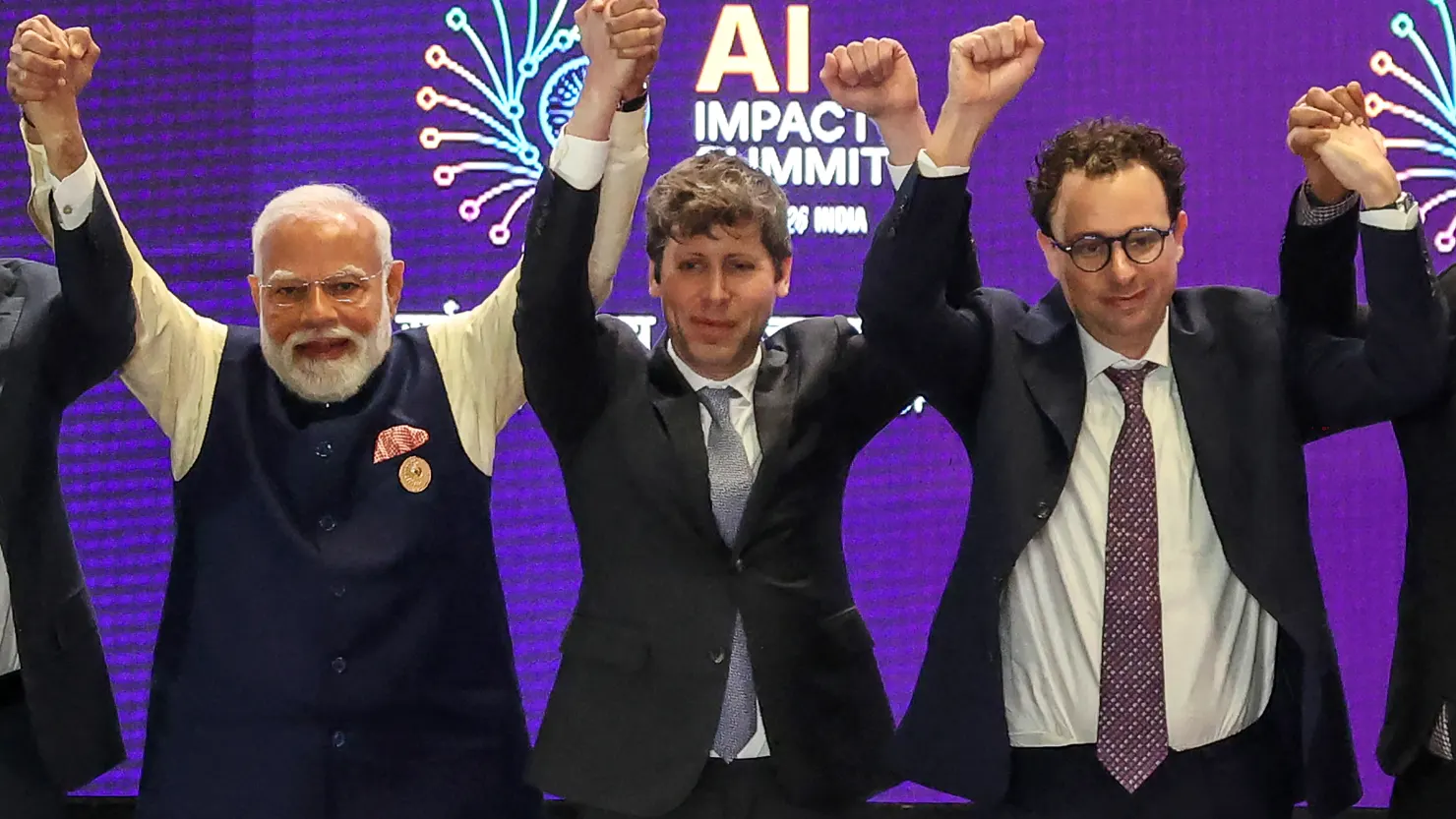
During a staged photo opportunity, Modi invited AI leaders to hold hands in a display of unity. But when Altman stood beside Dario Amodei, CEO of Anthropic, the two raised clenched fists rather than clasping hands. Social media quickly dissected the gesture, reading it as symbolic of intensifying competition between their companies.
Altman later said he was simply “confused” and unsure what he was expected to do.
The moment came just days after Anthropic aired a Super Bowl advertisement that appeared to criticize OpenAI’s reported testing of advertising within ChatGPT — adding another layer of intrigue to the rivalry.
India’s Enduring Lure
Despite the turbulence, the summit underscored a powerful reality: India remains one of the most compelling AI growth stories in the world.
Executives repeatedly highlighted the country’s strengths — from its deep technical workforce to its rapidly expanding digital infrastructure. The week also saw tangible commitments.
OpenAI announced it would become the first customer of Tata Consultancy Services’ data center business, signaling deeper integration into India’s technology ecosystem. Meanwhile, Google unveiled new partnerships with researchers and educational institutions to advance its Gemini AI initiatives in the country.
The optimism suggests that while organizational missteps may have overshadowed parts of the summit, they have done little to dampen global corporate appetite for India’s AI opportunity — often described as a potential $200 billion market in the years ahead.
Ambition Meets Reality
The AI Impact Summit was meant to signal India’s readiness to lead in the next technological revolution. Instead, it offered a more nuanced picture: a nation brimming with ambition and global support, yet still grappling with the operational demands of hosting a world-class event of this scale.
If the week revealed anything, it is this — the road to AI leadership, much like the traffic in New Delhi, may not always move smoothly. But for global tech giants chasing growth, the destination remains far too important to ignore.
Post Views: 1,535